diffs_summaries <- wide_LB_SR |>
summarise(n = n(),
mean_diff = mean(diffs),
sd_diffs = sd(diffs),
cohens_D = (mean_diff - 0) / sd_diffs,
se_diffs = sd_diffs / sqrt(n),
t = (mean_diff - 0) / se_diffs)• 15. The paired t-test
Motivating Example: You want to look into the differences between treatments in an experiment where pairs of otherwise identical individuals receive different treatments.
Learning Goals: By the end of this section, you will be able to:
- Identify the difference between “paired” and “unpaired” data.
- Explain the paired t-test as a one-sample t-test performed on the differences between pairs.
- Visualize paired data to highlight within-pair differences.
- Calculate and interpret a paired t-test in R, including the mean difference, confidence intervals, t-statistic, and p-value.
- Assess the assumptions of a paired t-test, focusing on the distribution of the differences.
The paired t-test
A common use of the one-sample t-test is to compare groups when there are natural pairs in each group. These pairs should be similar in every way except for the treatment difference we are investigating.
We cannot just pair random individuals and call it a paired t-test.
For example, suppose we wanted to test the idea that more money leads to more problems. We give some people $100,000 and others $1 and then measure their problems using a quantitative, normally distributed scale.
- If we randomly gave twenty people $100,000 and twenty people $1, we could not just randomly form 20 pairs and conduct a paired t-test.
- However, we could pair people by background (e.g., find a pair of waiters at similar restaurants, give one $100k and the other $1, then do the same for a pair of professors, a pair of hairdressers, a pair of doctors, and a pair of programmers, etc., until we had twenty such pairs). In that case, we could conduct a paired t-test.
Paired t-test Example:
I miss our parviflora plants too much - let’s get back to them. Recall that Brooke created lines (RILs) of parviflora plants. Although each RIL differed from all the others, each RIL can be replicated (by self-fertilization), so Brooke planted genetically identical genotypes at each location.
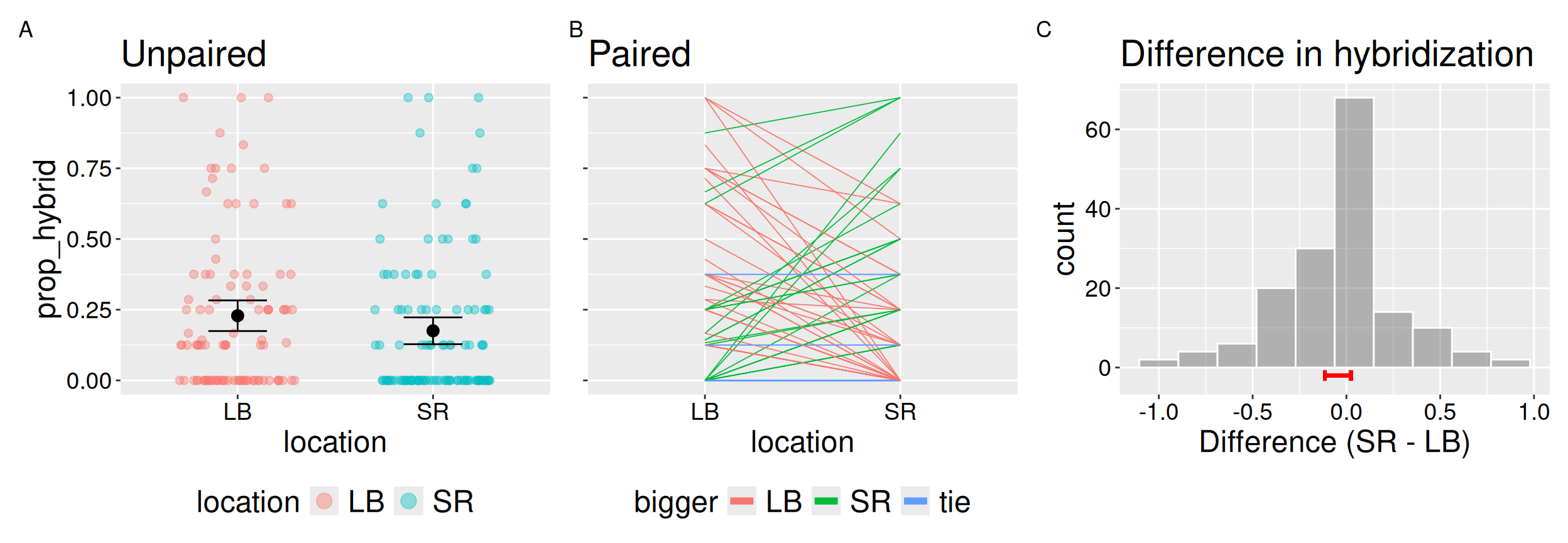
We can therefore test if the hybridization rate differs across locations. Here we focus on two locations – Lower Breckenridge (LB) and Sawmill Road (SR). The data are presented in Figure 1. Panels A and B show the same data in unpaired and paired form; panel C shows the distribution of within-RIL difference.
The next chapter introduces the two-sample t-test. A paired t-test generally provides more statistical power to reject the null hypothesis and estimates the difference in means with less uncertainty than a two-sample t-test. However, the two-sample t-test is useful because it can be applied when data are not paired.
Below I introduce the paired t-test, which tests the null hypothesis that the mean difference between pairs is zero. To do this, we run a one-sample t-test on the differences within each pair. This means our degrees of freedom equals the number of pairs minus one. By accounting for variation between RILs, the paired t-test focuses on differences within each pair. This often increases statistical power (i.e. our ability to reject a false null hypothesis).
Evaluating assumptions
Because a paired t-test is simply a one-sample t-test on the differences in each pair, all our assumptions apply to the distribution of differences within pairs. In other words, the paired test converts two measurements per pair into a single variable: the difference.
We know that data are independent and collected without bias (way to go Brooke!). I also think that the mean seems like a reasonable summary of the data.
However, I know that the differences in each pair are not perfectly normal because:
- The original data are bounded between zero and one - so differences are bounded between negative one and one.
- The data are discrete – it’s one proportion minus another (each usually in increments of one eighth, as we usually assayed eight offspring).
- It also looks like there are an excess of zeros (i.e. the data are zero-inflated) because many RILs made zero hybrids at both sites.
But we’re not looking for a perfect normal distribution. We want the data to be normal enough so that we believe in our statistics. Because the t-test is robust to minor violations of the normality assumption, and because our qq-plot (Figure 2) doesn’t look so bad, we can move on and do some stats.
ggplot(wide_lb_sr, aes(sample = diffs))+
  geom_qq(size = 4)+
  geom_qq_line()+
  theme(axis.text = element_text(size = 24),title  = element_text(size = 24),
        axis.title = element_text(size = 24),subtitle  = element_text(size = 18))+
  labs(title = "QQ-plot", subtitle = "Difference in hybridization",
       x = "Theoretical quantile", y= "Observed (SR - LB)")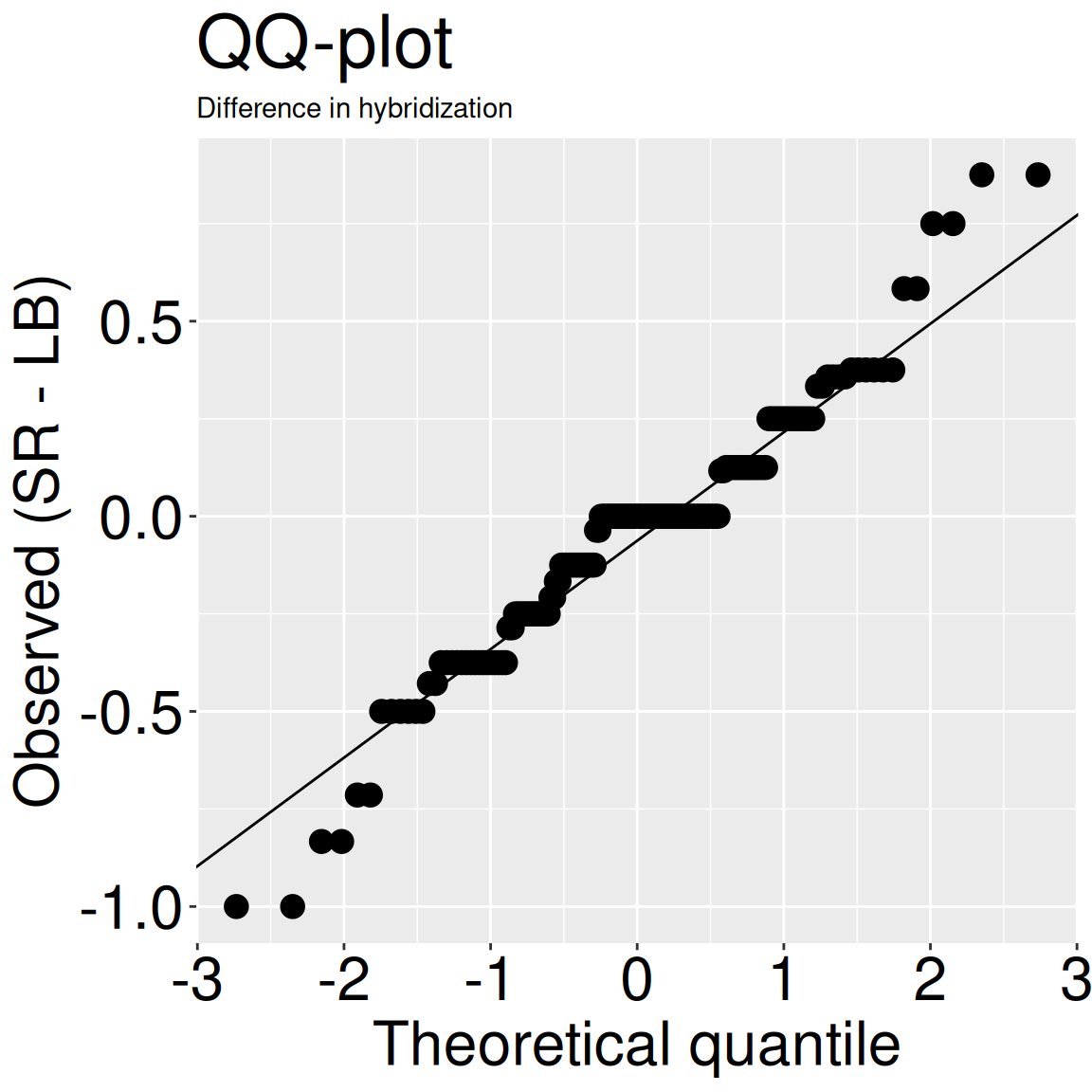
Summarizing data
While you are free to report means and confidence intervals for each “treatment” in a paired t-test, we are actually focused on the differences between pairs. In the tibble below, I have calculated this as:
\[\text{diffs} = \text{Prop hybrid}_\text{ Sawmill Road} - \text{Prop hybrid}_\text{ Lower Breckenridge}\]
So, we can now calculate the relevant summary stats:
| n | mean_diff | sd_diffs | cohens_D | se_diffs | t |
|---|---|---|---|---|---|
| 80 | -0.046 | 0.312 | -0.147 | 0.035 | -1.317 |
🛑 STOP 🛑
Before doing the whole NHST thing, you should immediately notice two things:
- Because Cohen’s D is in the “tiny” (0.01 – 0.20) range, even if the estimated effect was true, it would not be particularly strong.
- This will not be significant at the \(\alpha = 0.05\) level – results will never be statistically significant when the absolute value of t is less than 1.96.
But let’s move on to a formal test because we’re doing it.
The paired t-test in R
If your data are formatted like these (see margin), the t.test() function provides two equivalent ways to conduct a paired t-test. Both approaches give the same result, since they are just two ways of formulating the same test. I show you how to do them below:
- The one sample version:
t.test(x = DIFFERENCES, mu = 0).
- The paired version:
t.test(x = CONDITION ONE, y = CONDITION TWO, paired = TRUE).- For this version the \(i^{th}\) entry of
xandyshould refer to the same pair (pair, i).
- For this version the \(i^{th}\) entry of
| ril | LB | SR | diffs |
|---|---|---|---|
| A1 | 0.125 | 0.000 | -0.125 |
| A100 | 0.375 | 0.250 | -0.125 |
| A106 | 0.000 | 0.000 | 0.000 |
| A111 | 0.000 | 0.125 | 0.125 |
t.test(x = pull(wide_LB_SR, diffs))
    One Sample t-test

data:  pull(wide_LB_SR, diffs)
t = -1.3171, df = 79, p-value = 0.1916
alternative hypothesis: true mean is not equal to 0
95 percent confidence interval:
 -0.11535736  0.02348236
sample estimates:
 mean of x
-0.0459375 t.test(x = pull(wide_LB_SR, SR),
y = pull(wide_LB_SR, LB),
paired = TRUE)
    Paired t-test

data:  pull(wide_LB_SR, SR) and pull(wide_LB_SR, LB)
t = -1.3171, df = 79, p-value = 0.1916
alternative hypothesis: true mean difference is not equal to 0
95 percent confidence interval:
 -0.11535736  0.02348236
sample estimates:
mean difference
     -0.0459375
Because our p-value exceeds 0.05 we fail to reject the null.
Concept check: We failed to reject the null. This means