normal_sim <- tibble(x = rnorm(mean = 1.78, sd = 0.1, n = 1000) )

normal_sim |>
  mutate(within_sd = x > 1.68 & x < 1.88) |>
  summarise( prop_within_sd = mean(within_sd))
# A tibble: 1 × 1
prop_within_sd
<dbl>
1 0.686Motivating scenario: We want to learn how to use R to generate random samples from a normal distribution to build intuition and verify its theoretical properties.
Learning goals: By the end of this chapter you should be able to:
Earlier, I showed you how to use a web app or R’s pnorm() function to calculate probabilities from a normal distribution. Here, I introduce R’s rnorm() function to generate random data from the normal distribution. The simple rnorm() simulation below will give us the same answer as our calculations above. I teach simulation because I think its randomness builds intuition, and because simulation also works in more complex cases where there isn’t a mathematical answer.
rnorm()We previously saw that about 68% of a normal distribution falls within one standard deviation of the mean. We can validate this for ourselves by a simple simulation, using our log-transformed petal area (\(X \sim \mathcal{N}(1.78,\,0.01)\)) as an example. To do so
rnorm() (see simulated data in the margin).normal_sim <- tibble(x = rnorm(mean = 1.78, sd = 0.1, n = 1000) )
normal_sim |>
mutate(within_sd = x > 1.68 & x < 1.88) |>
summarise( prop_within_sd = mean(within_sd))# A tibble: 1 × 1
prop_within_sd
<dbl>
1 0.686This is close to our mathematical result, but sampling variability leaves this a bit off our precise expectation of 0.6826895.
rnorm() (and all _norm() functions) defaults to the standard normal, so rnorm(n = 10) generates a sample of ten observations from a normal distribution.
We know by now that the standard error is the standard deviation of the sampling distribution. I briefly informed you that for the normal the mathematical formula for the standard error of the mean is:
\[\sigma_\bar{x} = \sigma/\sqrt{n}\text{ where: }\]
Let’s convince ourselves of this by simulation and then make sure that \(\approx 68\%\) of sample means, \(\bar{x}\) are within one SE of the population mean \(\mu\).
To do so we will set up a scenario in which our simulation results are “grouped”. Summarizing each sample with the mean generates a sampling distribution.
Note for the simulation below:
mu               <- 0
sigma            <- 1
sample_size      <- 9
n_samples        <- 100000

normal_sampling_sim <- tibble(
  x = rnorm(mean = mu, sd = sigma, n = sample_size * n_samples),
  group = rep(1:n_samples, each = sample_size)
)

sample_means <- normal_sampling_sim |>
  group_by(group)   |>
  summarise(mean_x = mean(x))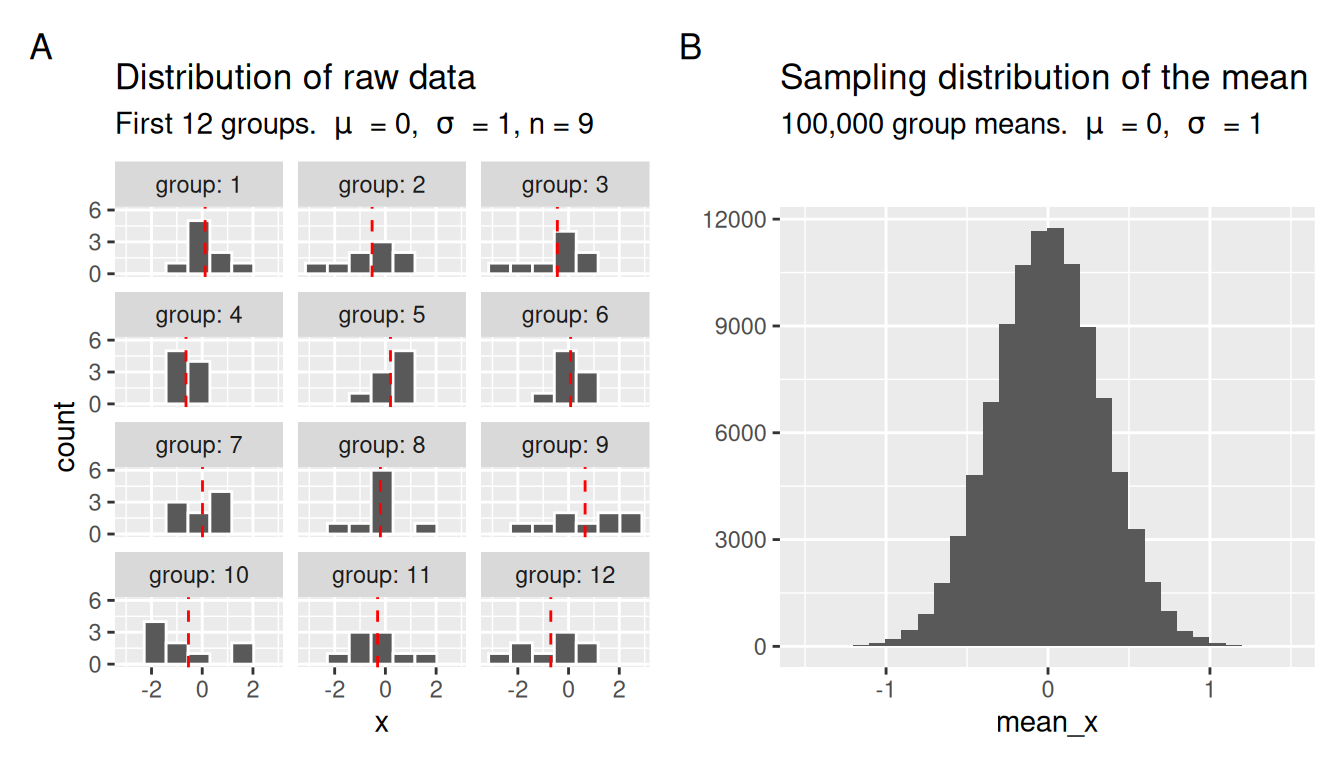
We can calculate the standard deviation of the sample means in Figure 1 as shown in the margin. You can see that the standard deviation of the sampling distribution of the standard normal with a sample size of 9 is approximately \(1/3\), which reassuringly is the standard deviation (\(\sigma = 1\)) divided by the square root of the sample size, \(\sqrt{n} = \sqrt{9} =3\).
sample_means |>
  summarise(se = sd(mean_x))
# A tibble: 1 × 1
se
<dbl>
1 0.332We expect, for example, \(\approx 68\%\) of draws from the normal to be within one standard deviation of the mean. We similarly expect \(\approx 68\%\) of sample means to be within one standard error of the population mean (i.e. between \(\mu-\frac{\sigma}{\sqrt{n}}\) and \(\mu+\frac{\sigma}{\sqrt{n}}\)). We can confirm this was true of our simulation as follows:
se    <- sigma / sqrt(sample_size)

sample_means |>
  mutate(within_one_se     = mean_x > mu - se &    mean_x < mu + se) |>
  summarise(prop_within_se = mean(within_one_se))
# A tibble: 1 × 1
prop_within_se
<dbl>
1 0.684